Thursday, October 25, 2012

Time for Shakespeare


It seems to be obligatory to set Shakespeare’s plays in some period other than Shakespeare’s own. I don’t object to this strategy; it’s been going on for decades if not centuries. But I do occasionally find the results of juxtaposing the playwright’s poetic 16th-century cadences with modern settings curious, though often curiously compelling.

Recently the Indiana University production of Richard III set the action in the ambience of competing motorcycle gangs. (One thinks immediately of West Side Story, the Leonard Bernstein musical that retells Shakespeare’s Romeo and Juliet through rival street gangs.) In this case the choice seemed cued by some analytical remarks by author Josephine Tey, helpfully included in the program notes:

For thirty years, over this green uncrowded land, the Wars of the Roses had been fought. But it had been more of a blood feud than a war. A Montague and Capulet affair; of no great concern to the average Englishman…. It was a small concentrated war; almost a private party.

Biker leathers with clan emblems and embroidered roses—now universally called Tudor roses—fit the notion of internecine strife, white rose versus red rose. A modernist and timely touch was the addition of “fact-checking,” a nod to the current presidential election season in which the usual political falsities are revealed by various fact-checking organizations. In this instance a television screen flashed periodic historical corrections that played against Shakespeare’s Tudor-slanted take on events. Shakespeare’s histories, in particular those of times and figures most immediate to his own era, were propagandistic, designed to conform to the views of Elizabeth I, who, like her father Henry VIII, was not a monarch to be crossed without mortal peril.

All in all, I found the biker motif added rather than detracted from the essence of the play. The darkness worked for this dark, brutal, bloody drama in a way similar, but in stark contrast, to the IU production of The Taming of the Shrew this past July. That staging set Shakespeare’s boisterous romantic comedy in a South Beach, Florida, sort of place, which also worked well: a light-hearted play set in a light-filled locale.

Tuesday, September 11, 2012

Gore Vidal's Box Set


Vidal at 23, photographed by

Carl Van Vechten in 1948

When Gore Vidal died in July at age 86, I belatedly discovered that he had written three mystery novels in the early 1950s, under the penname Edgar Box. An inveterate mystery reader, I take particular delight in discovering mystery novels written by persons best known for other pursuits. (A favorite example is striptease artist Gypsy Rose Lee, who penned two mysteries in the early 1940s, the first titled, appropriately, The G-String Murders.)

Gore Vidal, aka Edgar Box, cranked out three mysteries in quick succession: Death in the Fifth Position (1952), Death Before Bedtime (1953), and Death Likes It Hot (1954). They were reissued in a single volume, titled Three By Box, in 1978. All three feature a reporter-cum-p.r. man, Peter Sargeant, as the amateur detective. Sargeant is a suave, if sometimes bumbling, sexual swordsman, almost a comic James Bond without the trappings of spydom. (Fleming’s 007, however, did not debut until Casino Royale in 1953.)

Despite its heterosexual hero, the first of Vidal/Box’s trio is an unabashedly gay—in both old and new senses of that word—romp along the lines of Oscar Wilde meets Raymond Chandler. The novel is a delicious foreshadowing of later flamboyant works, such as the outrageous Myra Breckinridge (1968), the movie version of which provided a final screen vehicle for the inimitable but often imitated Mae West, and the surreal and irreverent Live From Golgotha (1992).

Death in the Fifth Position is a surprising novel for the early Fifties for its frank, often gay, sexuality. But the treatment is not so surprising for Vidal, who had published The City and the Pillar in 1948. That novel offered a coming-of-age story about a young man coming to terms, healthily, with his homosexuality. Thus it flouted convention, which at the time regarded gay as synonymous with immoral, and so caused a scandal. The City and the Pillar was only Vidal’s third novel, and one can imagine an editor, on receiving the manuscript of Death in the Fifth Position a couple of years later, counseling the author to adopt a pseudonym for the latter book’s publication. I don’t know whether that happened, but I wouldn’t be surprised if it did. Of course, it could equally be the case of a “serious” writer not wanting to be associated with something as déclassé as a mystery novel.

By contrast, the second of the trio, Death Before Bedtime, is sadly pedestrian. It is a serviceable mystery but lacks punch and pizzazz. The third, Death Likes It Hot, regains some sparkle, rather like a second wind along about midnight after an evening of hard partying. But it doesn’t measure up to the first mystery either, and I’m inclined to think that Vidal must have felt as though, after this third effort, he had gotten mystery writing out of his system. Box was laid to rest.

Still, the three novels are entertaining and, as mysteries go, intriguing. They are worth taking up, though no one could be faulted for stopping after the first one.

Tuesday, August 21, 2012

Twenty-One


In 1989 my wife Diana and I had been married twenty-one years. We had met in high school and wed at age twenty. After two decades we had grown to a family of five with the addition of three children: a daughter in 1970, a son in 1976, and another son in 1987.

As part of our anniversary celebration I crafted a poem. It is so minimal as to be almost in code, but the chronology was ours. It was our own not-so-secret itinerary of twenty-one years.

Twenty-One

Two. One.
San Antonio,
Where we sketched the melody.
Who would have guessed?

Then? Emporia.
Now we are one.
Two. One.
Two in step.

A kind of dance, just we
Two.
Three. Four.
And then five. Amazing!

Sheboygan.
Amazing Zweibrücken.
Twenty-one years, stepping
In time.

Who would believe it?

I can give you a lyric.
The rhyme is clear too.
But I own no rhythm:
The rhythm is you.

Two years later, in 1991, Diana died during an asthma attack. A lifelong medical condition had suddenly turned vicious.

On August 22, 2012, another twenty-one years will have passed. It will be a sadder anniversary, marking the event of her death. In two decades I have moved on with my life, as one must. But I have never forgotten the two decades of joy Diana and I had together.

Twenty-One, Again

Two. One.
A decade, then another,
And one more year.
Who would have guessed?

Then? Well, that was
When the world ended,
Came crashing down.
Two became One.

Dance halted, music stopped.
And then—one life went on.
Twenty-one years, again,
Raced by.

Who would believe it?

Yet my empty arms
Still hold you,
And my aching heart
Still loves you.

Twenty-one then, twenty-one now,
But never time enough.


Monday, August 6, 2012

Singing Together


Ten years ago my partner, Sam Troxal, conceived the idea to start a men’s chorus in Bloomington, Indiana. This year the resulting Quarryland Men’s Chorus celebrated its tenth season by premiering a commissioned work, Will and Testament, by composer Greg Gilpin, at its spring concert at First United Church. The chorus followed that with its first-ever performance at the GALA Choruses Festival 2012 in Denver, Colorado, in July. The new commission was part of their festival set. A clip from Will and Testament, sung at the sendoff concert in June, can be heard on YouTube, along with other tidbits of performances and rehearsals.

GALA was a signature event for the ten-year-old chorus. More than six thousand performers and others from more than 250 gay, lesbian, and ally choruses crowded into the mile-high city for four and a half days of sheer magic—the magic of singing together. Choruses ranged from a handful of singers to well over a hundred voices. Overlapping strands in three, sometimes four, concert halls made it impossible to hear every chorus. But the sounds were incredible, by turns funny and moving.

The power of communal song was never more evident than in this gathering—not a competition, but a celebration. A celebration of our collective strength as gay men and lesbians and our friends, our collective voices as singers and supporters, and our collective humanity, having gathered for the most positive of all artistic endeavors: singing together.

Personally, one of the most moving and energizing aspects of the festival was the inclusion of youth choruses. Some forty years ago, when I was a beginning teacher in a Wisconsin junior high school, we used to troop all of the students into the auditorium from time to time for what we referred to as a “community sing.” It was an opportunity for students to learn proper audience behavior, of course. But most of all it was an opportunity for all of us—students, teachers, and administrators—to sing together.

This occurred before the assault on the arts began to rob schools of art, music, and theater programs; before the energy crisis led to the disastrous decision to convert the school’s WPA-era auditorium into a cafeteria; before the more recent ill-conceived advance of test, test, test ideology that today overwhelms and often edges out good teaching in all subjects and the arts writ large, in particular.

Recently I glimpsed that positive power of communal singing in a group I discovered on YouTube: Only Boys Aloud. This 133-voice chorus composed of Welsh lads, ages 14 to 19, is mind-blowingly inspiring. One can only hope that educators here, across the United States, can rediscover the positive power for community building, cooperation, collaboration, and learning of singing together.

Tuesday, June 19, 2012

Walking Wounded


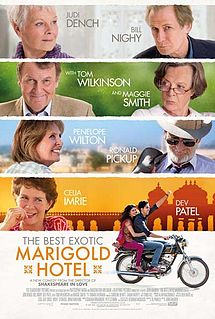
A couple of weeks ago my partner, Sam, and I saw the movie, The Best Exotic Marigold Hotel, starring a clutch of senior Brit actors—Maggie Smith, Judi Dench, Tom Wilkinson, Bill Nighy, and others—and the younger, charming Dev Patel. The story is about a group of British elders who decide to “outsource” their retirement and move to a hotel haven in India, only to find on their arrival that the haven is a hovel.

The film is a delight. It tugs at the heartstrings and tickles the funny bone, and, all in all, gives viewers a chance to see some of the best older actors around do their thing. The aging actors are resplendently wrinkled. Sam turned to me afterward and asked, “Didn’t they put any makeup on them?” It did make us wonder.

Perhaps it was seeing this movie that made my own age come home all the more in those moments when one looks in the mirror and wonders who might that be looking back. I’m still not quite a senior citizen—at least, not all the time. But I’m not far off.

Sitting in a coffee shop today, I became aware of an older woman passing by the window on her way in. Gray haired, probably in her seventies, she was still sprightly, dressed in rolled up khaki shorts. I noticed that her athletic shoes had been split in the back to accommodate braces on both ankles. The shoes and the braces, the shorts, not caring who noticed, all bespoke a certain indomitable spirit.

Seeing her inspired the poem that I jotted down once I got home. Perhaps it will strike a chord, particularly with my older readers.

Walking Wounded

We are the walking wounded,
Limping, bodies bent under years,
Torn pages from calendars, torn up,
Tossed like confetti. We celebrate

The wear and tear on joints
Used for running and jumping,
The wrinkles around eyes and mouths
From laughing at life, at ourselves.

I get the senior discount, sip coffee
Over old news and new stories,
Savor my small-portion banquets
And turn in early to wake even earlier.

I prize clear mornings and foggy mirrors,
Moments when I remember names.
We are walking, wounded, oh yes,
But we are walking all the same.

Thursday, May 10, 2012

Rubbing Musical Elbows


My musical talent, as the saying goes, would fit into a thimble with room left over for three raisins and a caraway seed. Consequently, I am in awe of those who make music, whether as composers or performers. In Bloomington, Indiana, where we have the renowned Indiana University Jacobs School of Music, you can’t throw a paper airplane without hitting an accomplished musician.

This means that ordinary folk like me get to rub elbows with some fascinating and accomplished individuals, whether it’s running into (not literally, thankfully) jazz and classical composer, conductor, and teacher David Baker on the jogging track at the local YMCA, being greeted at a reception by opera soprano Sylvia McNair, sharing lemonade and munchies with young harpists in the home of Susann McDonald, founder of the USA International Harp Competition, or enjoying a pitch-in dinner with music scholar and authority on the American composer Charles Ives, Peter Burkholder—and those are just four of the faculty. I did a double-take not long ago when I noticed that the keyboardist in a local rock cover band, playing a pizza joint-cum-music club that evening, was a well-known classical organist and IU professor that I’d last seen performing Bach in a much different setting.

But it’s the students that really awe me. The tenor or the soprano who’s soloing in our church choir not unusually can also be spotted in an opera on campus or a musical play somewhere in town, or may well be headlining at a local jazz club.

A recent acquaintance has been Texu Kim, an unassuming graduate student from Seoul, Korea. Tex, as he’s called, is doing doctoral studies in music composition at the Jacobs School. He’s so modest and unassuming that it took me several conversations to realize that this young composer is already amazingly accomplished. This past academic year alone he has flown to Paris and Frankfurt for premieres of his compositions.

In Paris this past January, the Ensemble Intercontemporain, directed by Finnish conductor Susanna Mälkki, performed his “Toccata Inquieta,” a work for solo harpsichord and ensemble. The harpsichordist was Dimitri Vassilakis. The concert also was broadcast in Germany on Deutschlandradio Kultur.

In an interview in Paris Tex cited influences from music played in Korean Christian churches, jazz, and rock, in addition to classical music. Tex studied chemistry before turning to music composition, and so he also tends to use mathematical and scientific principles as tools for musical composition.

In March the Paris premiere was followed by another in Frankfurt. This time the work was “Sketches for Contredanse,” with Peter Rundel directing the Ensemble Modern. The composition was included in a program with several other premieres in the Mozart Hall of the Alte Oper, or Old Opera (photo). Founded in 1980, the Ensemble Modern is one of the world’s leading ensembles of Contemporary Music. Currently, the ensemble is composed of musicians from Argentina, Bulgaria, Germany, India, Israel, Japan, Poland, and Switzerland.
For someone who’s “just” a grad student, Tex is well on his professional career path and doing splendidly.

Texu Kim is an outstanding example, but in Bloomington he’s also in good company. There aren’t many Midwest college towns in which the guy waiting on your table at a local restaurant could well be singing at the Met next year. 

Friday, April 27, 2012

A Dame at a Dig


Come, Tell Me How You Live is so little known among the works of Agatha Christie that it sometimes is omitted from her bibliography. The book, subtitled “An Archaelogical Memoir,” was written under her married name, Agatha Christie Mallowan, and published in 1946.

Agatha (nee Miller) Christie married Max Mallowan in 1930, having divorced her first husband, Archibald Christie, in 1928 after fourteen years of marriage. Mallowan was an established archeologist; however, his wife’s fame—though she would not be Dame Agatha until 1971, after her husband had been knighted in 1968—had already eclipsed his. By the time of their marriage, Christie had already published several novels, her first in 1920 being The Mysterious Affair at Styles. This mystery novel featured the first appearance of Hercule Poirot, her longest running detective. Styles, incidentally, was the name of the Christies’ house in Sunningdale, Berkshire.

Eventually, Agatha Christie would become the best-selling novelist of all time, her books selling approximately four billion copies in more than one hundred languages. Her play, The Mousetrap, famously, has been in constant production since its premier in 1952. She has been outsold only by the Bible and Shakespeare.

Come, Tell Me How You Live makes a delightful departure—as it must have been for Christie herself. It is a rambling, day-to-day memoir that recounts several seasons of archeological digs in the Middle East during the 1930s, prior to the Second World War. Reading it gives one some insight not only into the goings on of a dig in that period but into the character of Christie that in various ways becomes manifest in the array of personalities in her novels. This is a very human, interesting and interested individual, who pays attention to both the vast and the minute. And she’s funny! This memoir is truly entertaining to the point of chuckling aloud from time to time. So many memoirs take themselves far too seriously, and this one doesn’t fall into that trap.

Christie’s prewar Middle East digs provided fodder for several of her popular mysteries, including Murder in Mesopotamia (1936) and Death on the Nile (1937). When the war began, the digs ended and Christie set aside the memoir. In 1944 she took it up again, saying,

But now, after four years of war, I have found my thoughts turning more and more to those days spent in Syria, and at last I have felt impelled to get out my notes and rough diaries and complete what I had begun and laid aside. For it seems to me that it is good to remember that there were such days and such places, and that at this very minute my little hill of marigolds is in their bloom, and old men with white beards trudging behind their donkeys may not even know there is a war.

Readers today are the richer for Christie having taken up the memoir she laid aside before the war. And we can see, through her keen eyes, into a world that has, unfortunately, been largely lost forever.