Tuesday, October 1, 2013

Stray Lamb


“I always suspected,” says protagonist T. Lawrence Lamb, “that an investment banker and a second-story man had a great deal in common.” The line is from a 1929 novel. It’s prescient, considering what happened in late October that year—the Wall Street Crash. That debacle tipped the United States into a ten-year Great Depression, echoed most recently in the crash of 2008, from which the U.S. economy is still recovering. Mr. Lamb is an investment banker. He has a point. The banker-burglars of 2008 have yet to be held fully accountable for the financial hardships they and their conservative political backers imposed on the American people. Recovery is still incomplete, and rightwing politicos seem bent on ensuring that it ever will be.

Mr. Lamb, however, is a comic character, and the novel by Thorne Smith in which he appears is merely a bit of fun. It’s called The Stray Lamb. I stumbled on it when I pulled a long-neglected volume from a dusty corner of my bookshelf, The Thorne Smith 3-Decker, a Doubleday, Doran and Company edition from 1939. I don’t recall where I picked it up, some book sale or other, I suppose. But it’s a delightful dive back into the murky madcap humor of a bygone era.

Thorne Smith
James Thorne Smith, Jr. (March 27, 1892 – June 21, 1934), who wrote under simply Thorne Smith, may be best remembered for two Topper novels. The original Topper (1926) and its sequel Topper Takes a Trip (1932) starred another banker, Cosmo Topper. Smith’s bankers, saddled with unsatisfactory wives, invariably get into outrageous scrapes. These novels led to a series of film and television versions. The first film, Topper, was a Hal Roach vehicle for Metro-Goldwyn-Mayer in 1937, featuring Roland Young and Billie Burke, with a cast that included Cary Grant and Constance Bennett, who were the bigger stars. An American television series of the same name began in 1953 and starred Leo G. Carroll as Cosmo Topper. The pilot and several early episodes were written by Stephen Sondheim.

Thorne Smith’s urbane, zany novels are redolent of the abandon of the Roaring Twenties. There’s an abundance of sex and alcohol. Whether sex figured in Smith’s own life, I don’t know. Alcohol certainly seemed to, by all accounts. He died of a heart attack at age 42.

Mr. Lamb’s tale is the first novel in The Thorne Smith 3-Decker, which also includes the novels, Turnabout (1931) and Rain in the Doorway (1933). The last broadcast episode of the original Star Trek television series, “Turnabout Intruder” (1969), was based on Turnabout. Perhaps I’ll read that one next.

Monday, August 5, 2013

When Love Trumps All


Jan Morris recently was voted 15th greatest British writer since the Second World War. Her award winning publications include the 1960 travel book Venice, which has never been out of print since it first rolled off the presses, and the history trilogy Pax Britannica. But her writing must take second place in this commentary to the romantic drama of her life.

Born James Humphrey Morris on October 2, 1926, the future Jan Morris became Britain’s leading journalist in the 1950s. After service in the 9th Queen’s Royal Lancers during the closing period of World War II, Morris was the Times correspondent who accompanied the British Mount Everest Expedition. Other prominent reporting followed. In many ways James Morris was much blessed. His successful career paralleled a successful marriage. In 1949 he had wed Elizabeth Tuckniss, and together they had five children.

But in 1964 James Morris began a medical transition that would culminate in a trip to Morocco in 1972, where he underwent sex reassignment surgery. James became Jan. Whatever interior struggles he had previously had in some ways at that time transitioned into her struggles to reformulate a life and a career.

Pax Britannica, begun by Morris while he was a man, was completed when she was a woman. And over time there followed a trove of other triumphs in literature, from travel books (The Matter of Wales, Trieste and the Meaning of Nowhere) to essays (Among the Cities, O Canada!, Contact! A Book of Glimpses), history, fiction, and memoir.

The British government had forced Elizabeth and her husband to divorce following Jan’s transition. At the time same-sex unions were not permitted. But the couple never stopped living together and loving one another.  Recently, on May 14 this year, Elizabeth and Jan tied the knot again in a Britain where same-sex civil unions are now sanctioned.

“I made my marriage vows 59 years ago and still have them,” Elizabeth told the Evening Standard, following their government-sanctioned reuniting. “We are back together again officially. After Jan had a sex change we had to divorce. So there we were. It did not make any difference to me. We still had our family. We just carried on.”

For Elizabeth and Jan, now in their 80s, love has consistently trumped sexual identity, convention, and all of the sturm und drang that so pervasively accompany the politics of sexual expression. Here is a case of two humans loving one another over the course of a lifetime, everything else be damned.

Thursday, July 18, 2013

The Art of Vilification


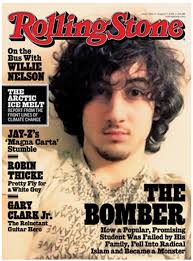
In the last day or two Rolling Stone magazine has been taken to task by many observers for publishing a cover photo of accused Boston bomber Dzhokhar Tsarnaev. Some major magazine sales outlets have refused to sell the issue.

At root is emotionalism, which, although it is understandable, must be tempered in a society that claims and expects to be governed by the rule of law. The operative term is accused. In the American justice system a person stands innocent until proven guilty. But Dzkokhar Tsarnaev has been judged by the court of public opinion. In that court, he’s already guilty.

If Rolling Stone should be taken to task, it would be more justifiably because the magazine is pandering to public vilification of this accused bomber, not by putting his photograph on the cover but by underlining it with the words “The Bomber.” The magazine has already judged him guilty, like much of the public.

That the photo has caused such outcry seems disingenuous. Perhaps the outcry is because Rolling Stone is more often thought of as a popular culture magazine than a serious commentator on hard news. Perhaps it is because the photo is not the usual image of a bedraggled prisoner awaiting trial that has become a standard form of public vilification, often of those not yet judged to be guilty but, like Dzkokhar Tsarnaev, awaiting their day in court.

Taken merely as subjects of current interest, accused and convicted criminals, murderers all, are frequently featured on magazine covers. It is a stock device of longstanding for Time magazine in particular. In 1943 Time featured a heroic portrait of Russian dictator Josef Stalin and named him its Man of the Year. More recently, in 1999, Time featured the smiling faces of Eric Harris and Dylan Klebold. They look like fresh-faced teenagers, but they are better remembered as the Columbine High School shooters. Saddam Hussein, Adolph Hitler, Muammar Gaddafi, Idi Amin, Timothy McVeigh, the list goes on, foreign and domestic—all have been featured on magazine covers.

This instance of featuring a killer, accused or convicted, is not a one-off for Rolling Stone. In 1970 Rolling Stone put mass murderer Charles Manson on its cover; Life had done the same the previous year. Does putting Dzkokhar Tsarnaev on Rolling Stone make him a “rock star,” as some have commented? My guess is that it doesn’t have that effect for most viewers, any more than putting Saddam Hussein’s smiling face on the cover of Time made him into a kindly father figure.
 
The old saw is that a picture is worth a thousand words. What those words are must be conjured up in the mind of the viewer. Rolling Stone’s use of this particular image of the accused Boston bomber feeds the imagination of different people in different ways. Those who have already judged Dzkokhar Tsarnaev guilty find the image too positive, too apparently innocent. The art of vilification demands a darker vision.

Sunday, June 30, 2013

Casual Racism


As several states raced to find ways to disenfranchise minority voters in the days following the Supreme Court’s decision regarding the Voter Rights Act, the Paula Deen debacle put paid to the notion that some sort of sea change has occurred and racism is no longer an issue in the United States. Racism clearly is still an issue. TV celebrity chef Deen’s tribulations have entertainment value in today’s scandal-driven media, but her missteps belie deeper societal problems. Racism has moved from the blatant to the casual.

For example, in June the U.S. Department of Housing and Urban Development (HUD) released Housing Discrimination Against Racial and Ethnic Minorities 2012. When minority buyers and renters show up, “This study finds that
 minority homeseekers whose ethnicity is more readily identifiable experience more discrimination than those who may be mistaken for whites.” The study notes that discrimination has diminished, but it has not disappeared in communities across the nation. Researchers included more than 8,000 tests in a nationally representative sample of 28 metropolitan areas.

Folks like the doyen of Southern comfort food will smile in your face, but don’t turn your back. Sure, Paula Deen probably wouldn’t pick up a handy butcher knife and stab you. But there are subtler ways for casual racists to damage those who are not like them. Like the minority homeseekers in the HUD study, you simply will be shown fewer properties or have a harder time getting an appointment. The racism is still there—less obvious, not gone.

“I is what I is,” Deen lamented with faux folksiness in a tearful Today Show interview. Well, Miz Paula, you might as well have trotted out that old saw, you know, about how “some o’ mah best friends is black folk.” Uh huh. The real problem is, you is a racist. Personally, I would rather Deen had said something along the lines of “I am working on overcoming the racism in which I was raised, but sometimes stupidity drops out of my mouth before I can stop it, and I’m sorry.” That might, or might not, have been a more honest response. After all, Miz Paula also added, “I’m not changing.”

For sensationalism seekers, a real apology wouldn’t have been as entertaining as Deen’s weepy self-justifying meltdown on national television. But it would have gone further to rehabilitate Deen’s image. And a more responsible, less emotional approach also would have acknowledged that racism, though less ardent than in prior years, still exists—and still negatively affects every American regardless of race and ethnicity in some way. Sadly, deny or defend are more prevalent strategies among casual racists, as we are now likely to see in issues of voter discrimination as well, following the High Court’s decision on the Voting Rights Act.


Tuesday, May 28, 2013

Why I Paint

Detail from a recent painting.

My walls are full—some might say overfull—of paintings, prints, drawings, and photographs. Many of the paintings are my own. I rarely sell one, though I give one away now and then when I think it won’t be taken amiss. I certainly don’t need to paint any more paintings, and I don’t think I’m much good at painting in any case. So why do I paint?

The easy answer is that I still enjoy it—when I don’t hate it. Painting challenges me. I never seem to be able to create the image in my head on canvas, but I’m often pleasantly surprised by what does appear. And if I’m not pleased, I can paint over it. A good number of my paintings have other, less successful works lurking beneath the surface. I like pushing paint around. Attacking a canvas is a visceral aesthetic. Often I do so to the accompaniment of rock music played loudly. Painting can be a total-body workout, feet shuffling like a boxer’s, hands slashing paint, mind running this way and that, contemplating moves like a chess player.

Mid-19th century, the Académie des Beaux-Arts dominated French art and therefore art writ large. The Académie was the embalmer of traditional painting standards: historical, religious, and mythological subjects, portraits, all carefully idealized realism in somber colors and no visible brush strokes.

Then along came the Impressionists, who liked color and everyday scenes—and visible brush strokes. Perhaps they also rebelled against the Académie because at mid-19th century the advent of photography was threatening to make realistic painting obsolete. Once freed from the constraints of the Salon, painting boarded a speeding train toward Modernism, which pervaded the 20th century. That was the train I got on about a half-century ago.

I’ve never entirely settled on a style of painting. The images I create veer toward Modernity but are as likely to be sidetracked by Impressionism. Put two of my paintings side by side and one might wonder whether they were created by different artists. My only defense is that, yes, they probably were. Each time I load a brush and approach a canvas, I am someone a little bit different from the person who last painted in my shoes.

Ralph Waldo Emerson said, “A foolish consistency is the hobgoblin of little minds, adored by little statesmen and philosophers and divines.” I make no judgment about whether I am foolish; I only know that I am not consistent. At least, not in painting. But I like doing it anyway. It’s good exercise.